In April of 1986 I was three years old. I have no memory of those days, of the fear and confusion surrounding the events at a Soviet power station in Ukraine. No one knew what the impacts would be; it was the first time in human history that the core of a recently operating nuclear reactor was fully exposed to the environment. It was unprecedented and terrifyingly so.
I wrote another post about it, and it is a good place to start to understand the how. Nuclear reactors do not generally explode. They are carefully designed to not be able to undergo a nuclear explosion like the kind in an atomic weapon. What happened at Chornobyl (I use the Ukrainian spelling because Slava Ukraini) was a steam explosion caused by a reactor going prompt critical (there’s another post linked in there to explain what that means).
The initial impacts were horrifying. According to the US NRC, 28 of the initial responders died of acute radiation syndrome (ARS) within a month of the accident and over 100 others received doses high enough to result in ARS. Hundreds of thousands of other workers would receive doses ranging from 1 rem to 100 rem. To put that into context, I have worked in the nuclear industry since I was 18 years old and haven’t received 1 rem total dose. Many of them would experience health effects in the future possibly linked to the accident.
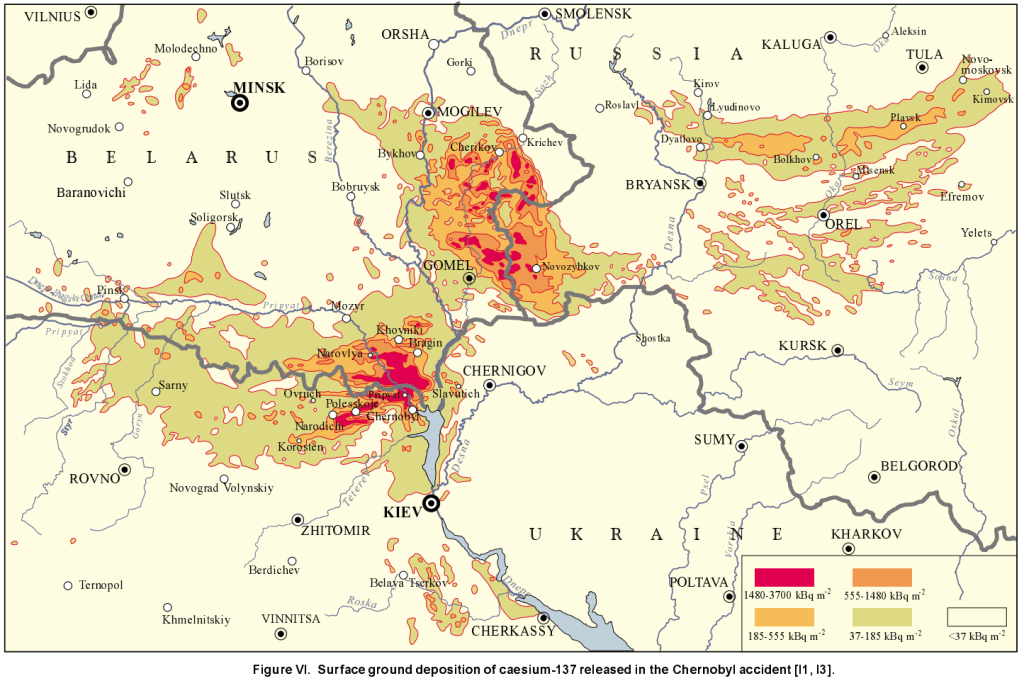
Due to the lack of a containment structure, massive amounts of radioactive isotopes were blown with the wind across Europe, with the highest amounts settling out within 30 km of the plant, mainly in Ukraine and Belarus. The map above is specific to Cs-137, but shows the dispersal pattern clearly, even showing how the fallout moved with the wind.
The map uses units of kBq/m2 which is thousands of Becquerels (Bq) per square meter. A Bq is the SI unit of radioactivity and is equal to 1 decay per second. A decay is what we call it when an atom releases radiation to achieve a more stable state. Your body contains about 5000 Bq of radioactive potassium-40, meaning at any given moment, 5000 atoms of K-40 are undergoing radioactive decay within your body.
The USSR evacuated an area 30 km around the accident area, eventually displacing nearly 350,000 people. The area, known as the Chornobyl Exclusion Zone, remains off-limits to settlement to this day, though some of the former residents have returned to finish out their lives where they began them.
So, the immediate impacts of the worst nuclear disaster to ever occur, including Fukushima, are approximately 30 people dead from ARS and 350,000 people evacuated from the surrounding area. A tragedy to be sure, but not the world ending consequences some fear a nuclear accident can cause.
Longer term effects have been studied continuously since the accident occurred. The biggest impact has been in incidence of thyroid cancer in those who were under the age of 10 when the accident occurred and ingested large amounts of iodine-131 from drinking fresh milk shortly after the accident. The thyroid absorbs iodine, so the radioactive I-131 is deposited there, giving a large direct dose to the organ. This is why officials may hand out potassium-iodide (KI) pills following a nuclear event. The thyroid becomes saturated with the non-radioactive iodine, preventing it from absorbing the I-131.
In a 2008 report, the UN estimated that approximately 6900 thyroid cancers in the most effected populations were attributable to radiation exposure from the accident. 15 of them proved to be fatal. There was also a significant increase in leukemia in the workers that cleaned up the areas closest to the plant over the next two years. The WHO estimated in a 2006 paper that the total deaths due to cancer caused by Chornobyl would be approximately 4000 in the groups most impacted by the contamination. Estimates vary widely based on the modeling used and the population analyzed, with the worst case projections being as high as 60000 deaths attributable to the accident over the proceeding decades.
As always with this kind of thing, the truth is probably somewhere in the middle. An April 2016 report for the European Parliament estimates approximately 16000 cases of thyroid cancer and 25000 cases of other cancers could be attributed to the accident through 2065. With several hundred million cases of cancer expected over this time frame, they estimate that the accident caused an overall increase in cancers of 0.01%. Outside of those in the most impacted areas, the increase in cancers is essentially impossible to discern from the normal background rate. So three year old me living in Florida has nothing to worry about from the tiny amounts of radioactivity that made it to the US from the accident. At 43, that theory seems to be playing out well.
The environmental effects of Chornobyl were also significant. The infamous Red Forest received that name as thousands of pine trees died from exposure to radiation, turning the needles a coppery red color. The area is still highly contaminated. During the Russian invasion of Ukraine, Russian soldiers made the mistake of digging trenches in the contaminated ground. Reports of them becoming afflicted with ARS are almost certainly false. There simply isn’t enough radioactivity remaining to cause such an acute affect. Long term, they should probably monitor for bone cancer from the Sr-90 still in the soil, but even that is probably not going to happen.
In the 4 decades since the disaster, the Chornobyl exclusion area has been reclaimed by wildlife. Wolves, bear, elk, deer, lynx, and even Mongolian horses thrive in the abandoned areas surrounding the plant. The majority of the animals show no sign of negative impacts due to living in areas with radiation 10 to 100 times higher than normal. Some mutations have been noted, such as frogs with darker skin, and wolves with increased resistance to cancer, but none of the three-eyed fish you might expect from watching Simpson’s episodes.
This is supported by studies around Fukushima as well, as wild boar, bears, and racoons have thrived in our absence. It turns out that having large numbers of people in an area is worse for the wildlife than a nuclear disaster.
This is disputed by certain groups, and there has certainly been an impact on the wildlife in these areas both physically and genetically, but the public perception that the exclusion zones surrounding nuclear disasters are wastelands where you will immediately die is simply not supported by the facts in any way.
The radiation in the area around Chornobyl has gone down significantly since the accident. The overall radioactivity in the area has gone down approximately 90% since the accident as the short-lived fission products like iodine-131 (half life of 8 days) have all decayed away. The most significant long lived radioactive isotopes, Cs-137 and Sr-90, both have half lives of approximately 30 years. This means that in the first 30 years since the disaster, half of the cesium and strontium has decayed into other elements. Put another 10 years onto that calculation, and there is only about 40% of the initial cesium and strontium remaining.
I know much of this will be controversial to some who read it. I am not trying to downplay the impact of Chornobyl. It is the worst nuclear accident to have occurred, and in my opinion the worst case for a nuclear accident at a civilian power reactor. We should design reactors to ensure that even in the event of a worst case accident, no one is harmed by the effects. Even reactors designed in the 1960s come pretty close to meeting this standard, and modern designs almost certainly do. Nuclear power can play a key role in ending fossil fuel use for electricity, alongside renewables, and it can be done safely.
Below are some links to support my statements and provide further reading if you are interested.
https://www.unscear.org/unscear/en/areas-of-work/chernobyl.html
https://www.nrc.gov/reading-rm/doc-collections/fact-sheets/chernobyl-bg
http://www.europarl.europa.eu/RegData/etudes/BRIE/2016/581972/EPRS_BRI(2016)581972_EN.pdf
https://cancerletter.com/guest-editorial/20210423_3/


Leave a Reply