Thanks to @nuclearanthro.bsky.social (check out his blog https://deusexatomica.wordpress.com/), we know that a contractor at Los Alamos National Lab accidentally exposed 4 colleagues to radiation while conducting an experiment with Cf-252. The dose ranged between 132 mrem and 195 mrem. As with so much of life, those numbers are meaningless without context.
To start, the measure we will use is called a rem. A rem is the amount of dose to that will cause damage in human tissue equivalent to 1 Rad of x-rays or gamma-rays. It is a dose equivalent. It combines the amount of energy deposited and the damage done to get an easily used number for all forms of radiation.
To boil that down to a more basic concept, it is a way to quantify approximate biological damage from exposure to different kinds of radiation.
For more info, the NRC has a brief explanation. https://www.nrc.gov/reading-rm/basic-ref/glossary/rem-roentgen-equivalent-man.html
When discussing our unwitting victims in the LANL event, they received 132-195 mrem. The m is just the prefix for milli, or 1/1000. So they received 132 thousandths of a rem. For people not familiar with prefixes like milli, 1000 mrem is 1 rem, just like 1000 millimeters is a meter.
So, how much dose is dangerous? Will they be turning into zombies any time soon? Unfortunately for the horror fans, no. There will be no ill effects from the dose.
The dose they received is actually a pretty small amount. It will add to their lifetime, or chronic, exposure, but will not cause any acute effects. The NRC has strict limits on the amount of dose a radiation worker can be exposed to over the course of a year. The federal limit for whole body exposure is 5000 mrem (5 rem) a year.
That’s right, 5000 mrem a year. The individuals who were exposed at the lab received a tiny fraction of the amount the NRC believes to be safe. This is a means to limit the chronic exposure to an individual over their working lifetime. At this level, the probability of an increased risk of cancer is not detectable against the normal risk.
But, chronic exposure isn’t the cool, face melting radiation you see in movies. That would be an acute exposure. An acute over-exposure results in immediate effects. If you watched the HBO series Chernobyl, when the firefighter picks up a piece of graphite ejected from the core and it burns him through his gloves, that is an acute radiation exposure.
These numbers aren’t exact because people respond differently based on physiological differences. That being said, the lowest dose that would be expected to cause acute effects is ~20,000 mrem (20 rem). At this level it is possible to experience some mild symptoms of radiation sickness, such as reddening of the skin and nausea. This is not expected to cause any long term issues, but may increase the risk of cancer later in life.
The minimum dose expected to cause acute radiation syndrome is 70 rem. This can present as nausea, vomiting, and diarrhea. Severity of symptoms depends on the dose. Doses less than 200- 300 rem are not expected to be fatal with proper medical care.
Doses of 200-300 rem are potentially fatal in 10-35% of the population after 30 days. The damage done to the body is extensive. Bone marrow, GI tract, and the nervous system are all impacted.
Somewhere between 300 rem and 500 rem is the LD-50. This is the dose that will kill 50% of the people exposed to it within 30 days. Bone marrow is completely destroyed, destroying the immune system with it. The GI tract dissolves, causing significant bleeding.
Between 400 rem and 1000 rem the likelihood of death increases further. Illness is immediate and severe. We are starting to get into the range of exposure that the first responders at Chernobyl received. Survival is unlikely, with over 60% of people exposed dying within 30 days.
Approximately 140 responders at Chernobyl received doses between 700 rem and 1300 rem. 28 of them died relatively soon after the accident.
Somewhere between 1000 rem and 5000 rem, survival becomes impossible.
In 1999, in Japan, three workers in a uranium production facility were exposed to between 500 rem and 2000 rem. The 2000 rem guy died in 12 weeks. The 1000 rem guy survived 7 months. He was resuscitated repeatedly at the insistence of his family. There are pictures online that I will not share here. Fair warning, they are intensely disturbing.
Somewhere around 100,000,000 mrem (100,000 rem) the radiation can be instantly fatal. It essentially shorts out your CNS and you die. To be honest, if I am going to get a fatal dose, I’d rather it be so much I just cease existing. It is infinitely preferable to what happened to the people who died from Chernobyl or the Japanese accident.
To tie this back to the unfortunate individuals at LANL, the doses received were minor. Due to the NRC operating off the linear no-threshold model, they assume that any exposure increases the risk of cancer, so even such minor issues are treated with significant concern.
To be fair, I would be extremely unhappy about being exposed without my knowledge. Not because I think anything bad would happen at those levels, but because of the carelessness that it displays. We take this stuff seriously for a reason.
Just to demonstrate the tiny amount they actually received, let’s assume they were in a field of 50 mrem/hr. I have no way of knowing this, but given the doses they received, this would be the highest I would expect it to be. It was probably much lower, but for a longer period of time. This would not be an unusual dose rate inside the radiologically controlled area at a nuclear plant.
Every hour they sat there, they would receive 50 mrem. It would take 100 hrs to reach the NRC dose limit of 5000 mrem (5 rem). It would take 1400 hrs to reach the threshold for ARS of 70000 mrem (70rem). They would have had to sit in that room for 8000 hrs to reach the LD50 of 400000 mrem (400 rem).
Most people in the US receive an annual dose of approximately 600 mrem. This is from the natural background radiation, as well as things like flying in an airplane, or getting an x-ray or MRI. Where you live has a huge impact on the amount you receive annually. Places at higher elevation, or with higher level of radon, experience higher annual doses. Check out the EPA calculator below if you’re curious for more specifics.
https://www.epa.gov/radiation/calculate-your-radiation-dose
The take away from all of this is that it takes an enormous amount of radiation to be immediately harmful to a person. It takes quite a lot to be harmful over longer periods of time. Here’s a fun chart to display some of that info.
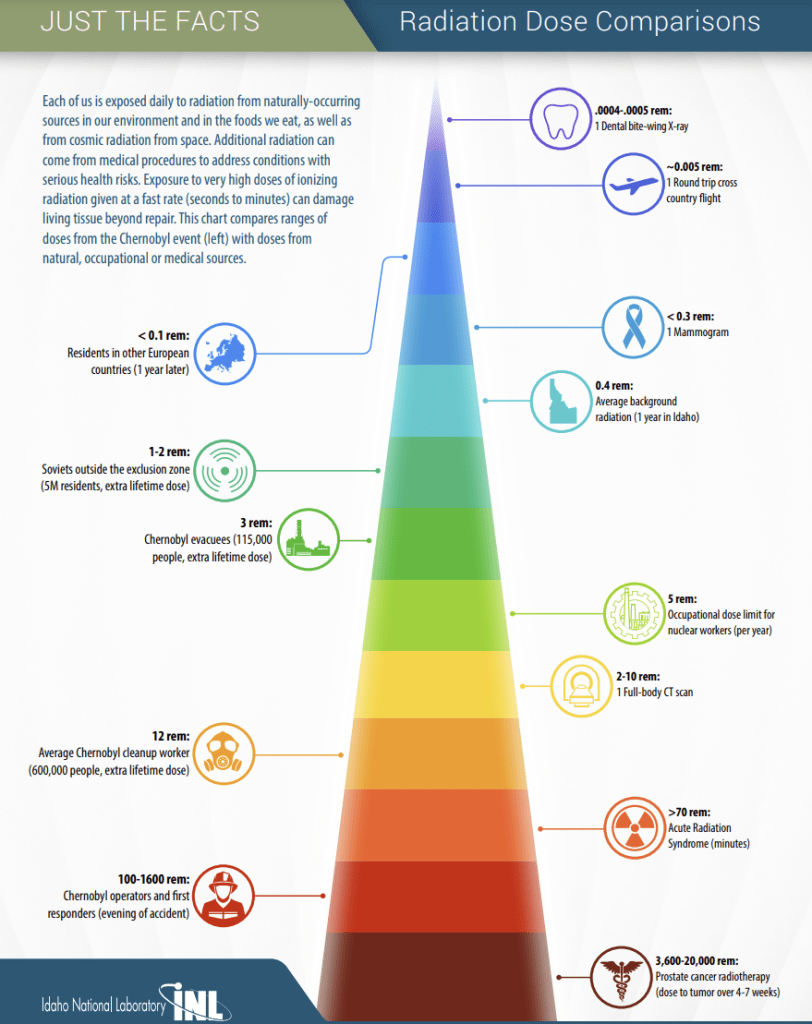
As always, this is open source. Here is some more info.
https://www.nrc.gov/reading-rm/doc-collections/fact-sheets/bio-effects-radiation.html
https://nrl.mit.edu/sites/default/files/documents/xkcd%20Radiation%20Dose%20Chart.pdf
https://inl.gov/content/uploads/2023/06/Radiation_Dose_Comparisons.pdf
This last link is useful because there are so many different units used when discussing radiation. If you see Sieverts or Grays, this link explains how that relates to rem.
https://hps.org/publicinformation/ate/faqs/radiationdoses.html


Leave a Reply