In the news today, there is a fire at the Zaporizhzhia NPP in Ukraine.

https://kyivindependent.com/russian-forces-start-fire-at-zaporizhzhia-nuclear-plant-ukraine-says/
From the looks of it, the fire is located in one of the cooling towers. Let me start by saying that the cooling towers are NOT part of the radioactive loop of the nuclear power plants. The water that is pumped through the towers is NOT in any way radioactive. It never comes into contact with the reactor. This is water that was used to cool the steam that went through the turbines, steam made from water that is also not ever in contact with the reactor in a PWR.
So, this event is not, by itself, a radiological hazard. It does, however, serve to remind us all that Russia continues to use the plant as a hostage, threatening Europe with memories of Chernobyl. While an accident at the facility is still possible, it is increasingly unlikely to have anything like the consequences of Fukushima, let alone Chernobyl.
The first reason the situation is getting less dangerous over time is time itself. The reactors at ZNPP have all been shutdown since September of 2022. When reactors are critical, they are producing a sustained fission chain reaction. This reaction produces fission products that decay over time. In addition to being a radioactive hazard, fission product decay is also what makes the risk of a meltdown linger long after the plants have shutdown.
These fission products release energy as they decay into other elements through the release of radioactivity. Decay heat is a function of power history. A reactor that was running at 100% power for six months will have more fission products, and therefore more decay heat, than a reactor that was only at 50% for that same six months.
As soon as a reactor is no longer critical, it stops producing significant amounts of new fission products. The fission products that were already in the reactor all have different decay times, usually expressed in terms of half life. A half life is the amount of time it takes for half of the radioactive element to decay into something else. The more radioactive something is, the shorter the half life, because it is decaying more quickly.
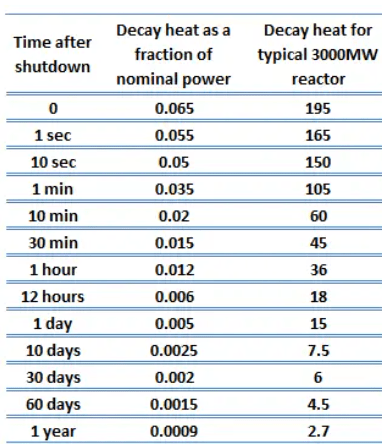
Decay heat falls off quickly from ~7% while at 100% power to about 1% within an hour of shutdown. It then slows down and takes years to reach levels where cooling is no longer required. A typical used fuel assembly will be in a spent fuel pool for 3 to 5 years before it no longer requires active cooling and can be transferred to a dry cask.
The fuel at ZNPP has not been critical for two years. Decay heat has fallen to the point that, even if the units lost cooling, it would take many hours for the water to boil and many more to uncover the core and risk a meltdown. This buys the operators time to deal with any situation that risks the fuel, and time is the most precious commodity when dealing with something like this.
The next reason the reactors are unlikely to cause a significant radioactive event is they are all in cold shutdown as of right now. This means the cooling water flowing through the reactors is less than 200F. If something bad were to happen to the reactor, say a large reactor coolant leak, the water is below the boiling point and will not flash into steam. There is much less energy contained in the low temperature, low pressure coolant now, than when the reactor is at 600F and 2250 psia.
Accidents are much less severe in a cold plant. This is reflected in the design of all US plants. When the reactor has been cooled down, we are only required to have half the safety equipment available that we normally would. This is due to the combination of the time aspect, and the lower energy levels in the system limiting damage from certain events.
The final reason is the containment structures. Fukushima released less than a third of the radioactivity that Chernobyl did. This is because all of the reactors are Fukushima were contained inside a massive containment structure. This serves to trap any radiation that is released inside the containment. Chernobyl did not have such a structure. All the reactors are ZNPP are inside a containment, as are the spent fuel pools.
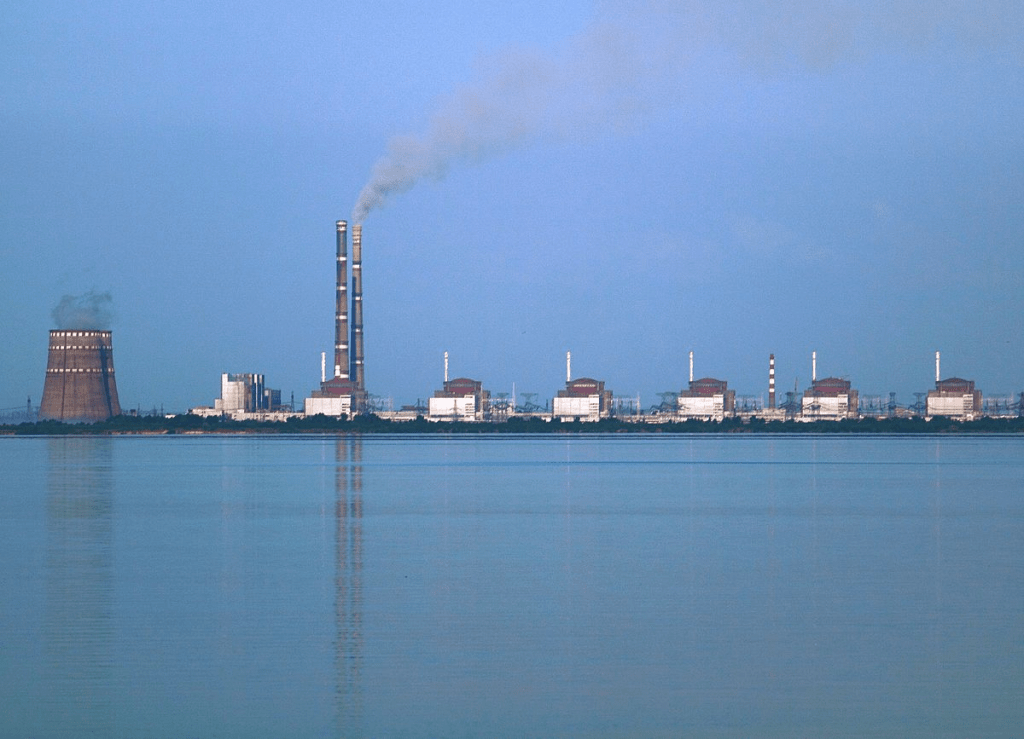
TLDR, I am not greatly concerned with an accident at ZNPP. If one were to occur, it would take intentional action by the Russian invaders to make it bad enough to cause a significant release of radioactive material. I would love to see a safe zone around the plant, just to forestall any unforeseen events from proving me wrong. Having wars around nuclear plants is an incredibly stupid thing to do, despite all the overengineering in these plants to make any danger minimal.
Here is the link to the table I used above.
 Sleepy Neutron's Nuclear Knowledge
Leave a comment