
Iran has been in the news quite a lot lately. Depending on which news organization is scaring you at that particular point in time, they are anywhere from a few months to a few weeks from having enough enriched uranium to make a nuclear weapon.
So, what exactly is enriched uranium and why is it needed to make a bomb? 99.3% of naturally occurring uranium is U238. The other .7% is mostly U235. U238 sucks for making bombs or nuclear fuel. U235 is the good stuff. For civilian nuclear fuel, U235 is about 5% of the mix. The Navy uses much higher levels of enrichment for the tiny reactors it uses on submarines and aircraft carriers. The uranium used in weapons production is generally 90% or higher enrichment.
The issue with natural uranium is that U238 does not fission easily. It takes an impact from a neutron of very high energy to get U238 to split apart and release energy. This type of material is referred to as fissionable, meaning we can make it fission, but it’s not easy. Most of the time, when U238 absorbs a neutron, it does not fission and that neutron is lost to the fission process.
U235, however, is fissile. Fissile material will undergo fission after absorbing just about any neutron that happens to hit it. This all has to do with the amount of energy required to force the fission to happen, known as the critical energy. In U235, the critical energy is fairly low. As long as the binding energy gained from absorbing a neutron is higher than the critical energy, fission will happen.
So, in order to run a nuclear reactor, or to build a bomb, you need to raise the percentage of your fuel that is U235. This is the hard part. U238 and U235 are chemically identical. This means that the way we separate different elements from one another using chemistry, or differences in melting point, will not work. Uranium is uranium as far as chemistry is concerned.
There are a couple of ways to do this, but they all involve the fact that U235 is ever so slightly less massive than U238. The Manhattan Project tried gaseous diffusion and electromagnetic separation. Modern enrichment facilities use centrifuges.
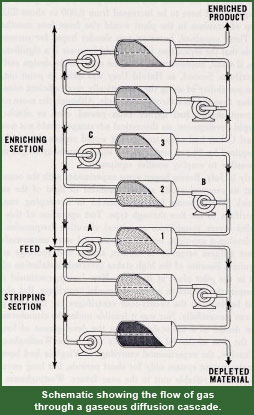
Gaseous diffusion forced UF6 gas through membranes that would only allow U235 to pass through. This was very slow and ended up being a secondary approach. The gas was highly corrosive and creating a barrier that would efficiently pass the U235, but not the U238 was extremely difficult. The output of the gaseous diffusion method was eventually used to feed the electromagnetic facility as it never reached a high enough enrichment on its own.
The electromagnetic separation method relied on passing the stream of uranium gas through a strong magnetic field. The UF6 containing the lighter U235 would be deflected more by the magnetic field than the heavier U238 ions.
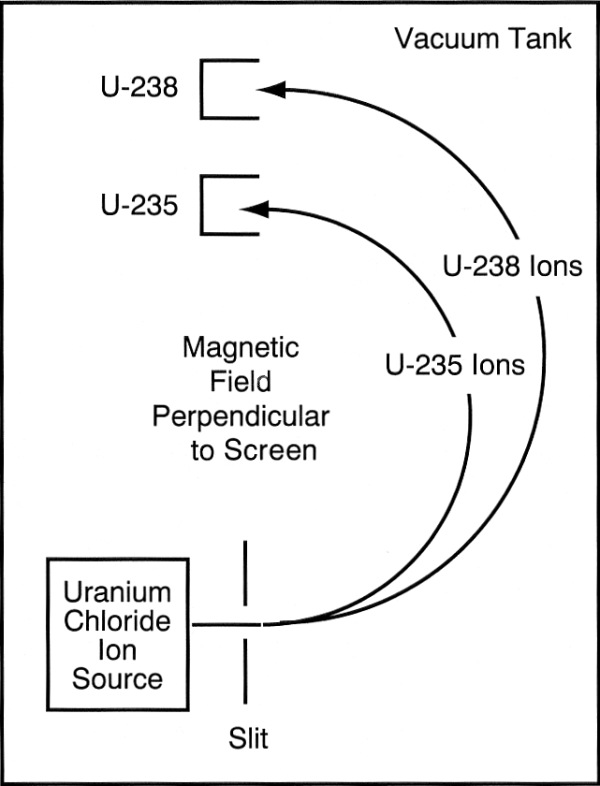
The streams would be collected in separate tanks. It took several runs through the system before the U235 had been sufficiently enriched to send it to another set of electromagnetic separators. It took the US years to get this right and produce enough U235 for a test and then the Little Boy bomb.
The massive effort the Manhattan Project undertook produced enough enriched uranium to produce the Little Boy bomb. The Fat Man bomb was a plutonium bomb. Plutonium is not naturally occurring and is a byproduct of running nuclear reactors. Plutonium production is beyond the scope of this article.
Modern technology has significantly increased the ability of technologically sophisticated countries to enrich uranium. Using the same principle of different masses, we now use centrifuges to separate the U235 and U238.
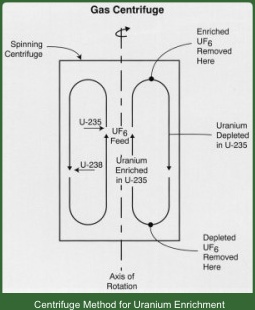
A uranium centrifuge works on the principle of acceleration varying due to differences in mass. As the centrifuge spins at 50k to 70k RPM, it forces the heavier U238 gas to the outside of the vessel. The lighter gas, now containing a higher percentage of U235, is pulled from the center and fed into another centrifuge. It passes through hundreds of these cycles, each time achieving a higher percentage of U235.
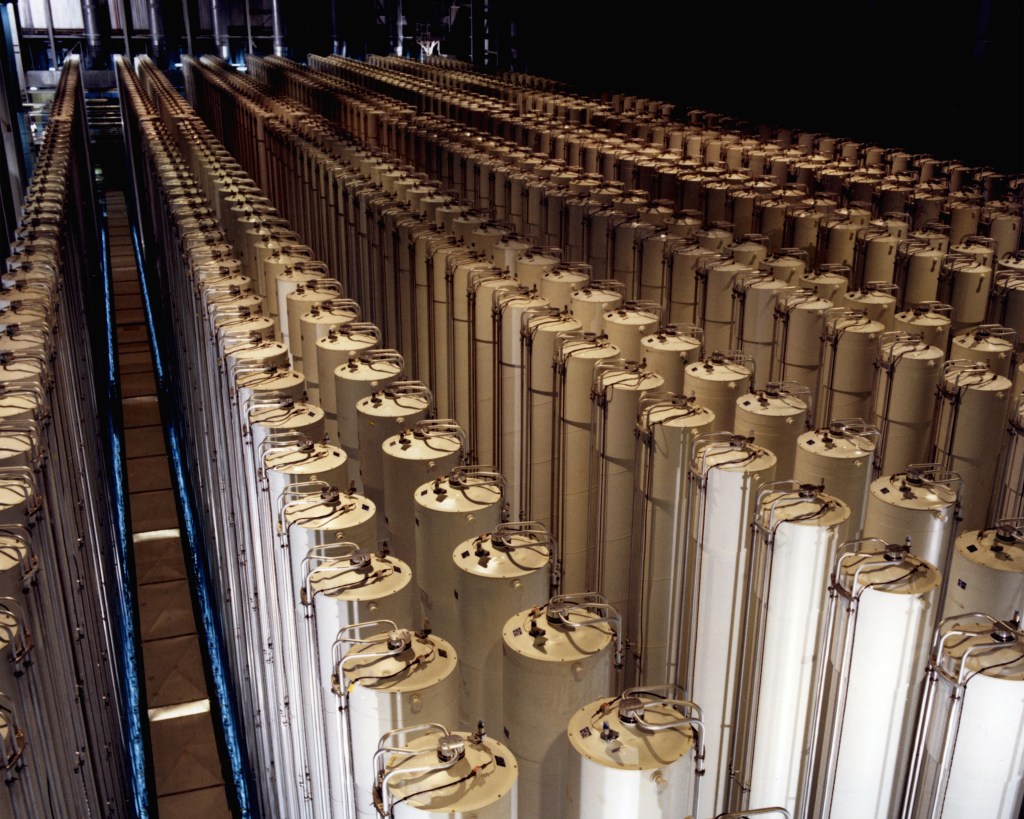
This is not a particularly fast process. It takes many months and many trips through the centrifuges to reach weapons grade U235 concentrations.
Iran has been working on its stockpile for many years. According to the IAEA, they currently have over 5000kg of uranium enriched to some extent. It would not take them very much time at all once the decision was made to process to 90% or greater. Based on IAEA reports of Iran’s capabilities, Iran would be able to produce enough WG U235 to make a weapon (~25kg) in seven days. It would be able to continue this production and possibly make enough for five to seven bombs a month.
So, yes, Iran could have what it needs to make a nuclear weapon in relatively short order. Having the material is a far cry from having a working nuclear weapon. As it turns out, building nuclear weapons is complicated and often doesn’t go as planned initially. North Korea has spent decades trying and has yet to test a device with any more explosive output than the bombs the US dropped in 1945.
For what it is worth, several other countries could develop nuclear weapons quickly. Japan and South Korea have large nuclear segments in their economy and the engineering expertise to quickly establish a weapons program. I am sure the Saudis would love to join that club, but so far we have not been that shortsighted as to encourage them.
As always, this is open source. Here are some good links. The diagrams and pictures above were all taken from the OSTI pages, which are really good references.
https://en.wikipedia.org/wiki/Enriched_uranium
https://www.osti.gov/opennet/manhattan-project-history/Events/events.htm
https://www.nrc.gov/materials/fuel-cycle-fac/ur-enrichment.html
 Sleepy Neutron's Nuclear Knowledge
Leave a comment