First, a disclosure. I am NOT a grid expert in the same way I am a nuclear power expert. I know quite a bit about the grid and how it works, but I have never operated it nor have I been trained to do so. It’s a highly complex system and takes a lot of highly trained folks to keep it running. That being said, I do know enough to explain what is happening in Texas right now and what happened in 2021.
There is one thing about the grid that matters more than anything else. Supply and demand must be in balance. If there is more supply than demand, grid frequency will rise. If there is more demand than supply, grid frequency will fall.
This has a ripple effect across the entire grid, causing the generators connected to that grid to speed up or slow down suddenly. If this is severe enough it can damage the generators and transformers that are the key components of the power grid.
The video above shows the effects of a large generating station going offline. The drop in frequency in the local area cascades around the entire interconnection. If this transient hits a plant that is already operating at its limits, it could damage that plant and cause it to fail, compounding the casualty.
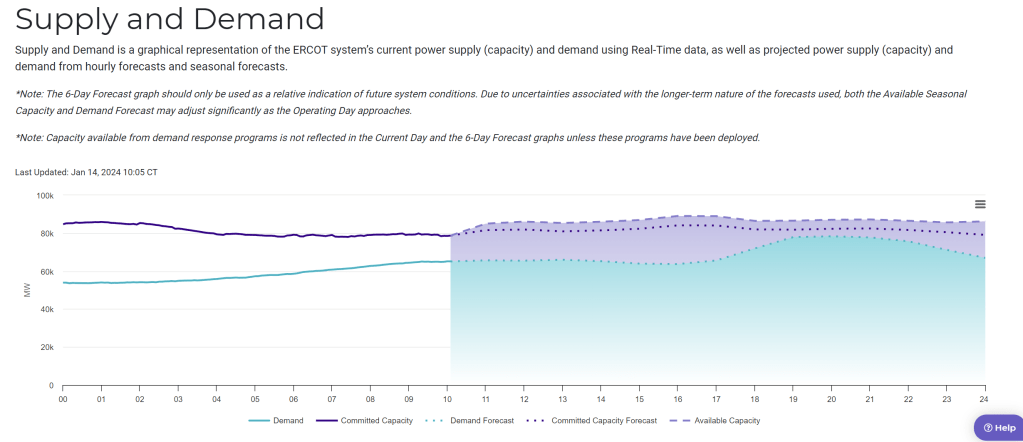
The above graph is the current supply and demand profile for ERCOT. ERCOT runs the grid in Texas. The solid lines are actual data, the dashed lines are projections for future supply and demand.
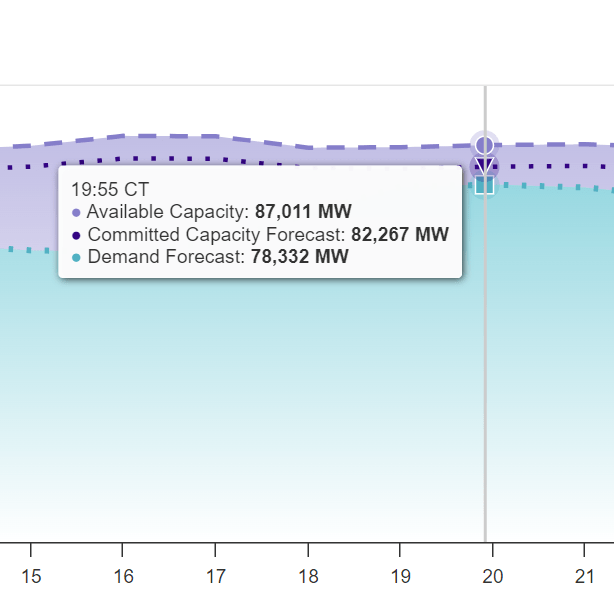
Zooming in on the section where conditions are expected to be the worst, we can see that demand is projected to reach 78,332 MW and available capacity is expected to be 87,011 MW. This means that ERCOT expects there to be enough power on the grid to meet the expected demand.
This is what you want. The grid will remain stable and no one should lose power. This projection assumes the loss of some amount of available generation assets, so this should be the worst case scenario for this years big freeze.
So, what happened in 2021?
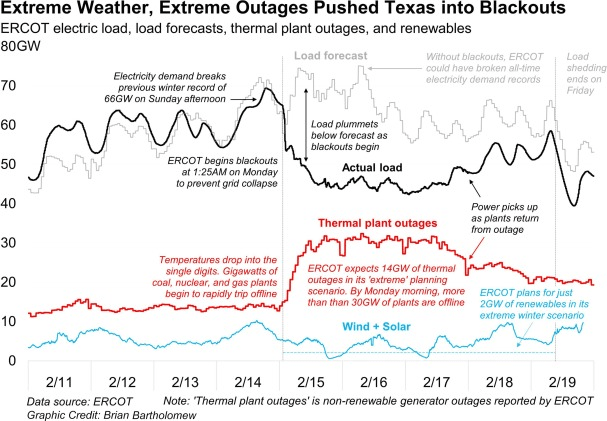
The extreme cold caused a number of coal, gas, and even a nuclear plant, to trip offline. This rapidly cut the power available to the grid. In response to this loss, grid operators began dropping sections of the grid. This reduces demand to within the available supply. (Wind and solar actually did fairly well. They were projected to only supply 2,000 MW, but often supplied much more. Unfortunately when the worst of the event was occurring, they were also at their lowest output.)
These controlled blackouts also caused issues in the natural gas distribution system as the pipelines lost power. Gas demand was already high due to the obvious need for heating. As pipelines lost power, the generating stations that relied on that gas began to go offline, compounding the issue. Further controlled blackouts were required to stabilize the grid.
ERCOT came very close to losing the entire grid in Texas. Dropping sections of the grid to lower demand is the only thing that kept the grid from collapsing completely. In an ideal (as ideal as a grid stability issues gets) situation, where the difference in supply and demand is relatively small, this is done in a rolling fashion. You drop a section for thirty minutes, then drop a different section before you recover the first part that was dropped. In this way, no one area is without power for very long and the grid operator keeps demand below available supply.
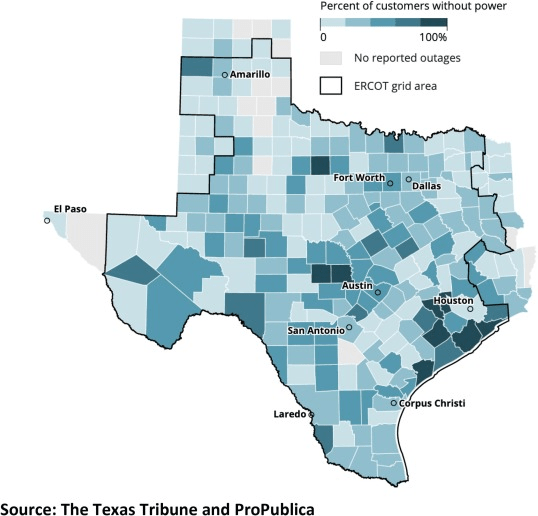
In the 2021 blackout, the difference in supply and demand was enormous. Demand peaked at almost 80,000 MW while supply fell to below 70,000 MW. Grid frequency dropped to 59.4Hz (60 Hz is normal in the US) for 5 minutes. Had ERCOT not taken action to reduce demand, the grid would have collapsed within minutes. At the worst of the event, nearly 50% of the grid capacity was offline. 4.5 million people lost power.
246 people died as a result of the freeze, according to official state estimates. Many researchers believe that to be a severe undercount. Some believe, based on their research, that nearly 1000 people died as a result of the storm and losing power in such cold temperatures.
I do not expect the upcoming freeze to be anything like the 2021 event. It’s not impossible. It is just not very likely. The 2021 event was extreme and Texas has taken action to improve the grids resistance to extreme cold. But, the rules for supply and demand are iron-clad and, as 2021 showed, Murphy’s Law applies.
links:
https://www.sciencedirect.com/science/article/pii/S2214629621001997
https://www.ercot.com/gridmktinfo/dashboards/supplyanddemand
 Sleepy Neutron's Nuclear Knowledge
Leave a comment