There are 2 ways to become an operator at a nuclear power plant. One is to get a BS degree, preferably in engineering of some sort, and apply for an opening at a plant. Spend a few years calculating things and then make the jump into operations for the big bucks. The other, until recently far more common way, is to give Uncle Sam 6 years of your life, and in return he will convince people you know how a reactor works. They will hire you and then spend a few years teaching you how a reactor works all over again.
This may surprise some of you, but a large number of the people running nuclear reactors, both military and civilian, barely graduated high school. I was one of them. I took night classes my senior year to get credit for things like English. (Who knew that teacher was serious about having a bibliography?) Anyway, I graduated by the skin of my teeth with a 2.57 GPA.
I chose not to try college. I drank enough in HS to know my chances of getting a degree were pretty slim. Many of my fellow Navy nukes (including my wife) blew tens of thousands of dollars in a vain attempt to make their parents happy before stumbling into a recruiter’s office. Not me. I decided to enlist the summer after my junior year. I took the ASVAB (got an 84, not great, not terrible) with the Army, but wasn’t really thrilled with the jobs they were offering. I talked to the Marine recruiters for a bit. They were worse than the Army, but my senior year was rapidly coming to a close, so I told them I would sign.
It was a Saturday, and when I got to the recruiting station no one was there. I poked my head in next door at the Navy recruiters and asked if they’d seen the Marines. I’m still not entirely sure how, but twenty minutes later I was in the Navy. They initially offered me advanced computers and electronics, but said that if I passed this other test I could be a nuke. No one bothered to explain what that meant, but I said “Sure, whatever.” Somehow I passed the NFQT, and in November of 2001 I left for bootcamp. Hindsight being 20/20, I dodged a lot of getting shot at because my Marine recruiter was too hungover to make it to work that day.
Becoming a Navy Nuke is a challenging endeavor. In 18 months they will cram 4 years of college level classes into your head. You will learn a whole new way to study, affectionately known as the fire hose method. Imagine drinking from a fire hose and you get the drift.
For the first 6 month you attend A School, where you learn your rating. I was an Electrician’s Mate, so I got to learn all about Ohm’s Law and how that makes motor’s spin. I might be paraphrasing a bit, but that was the gist of it. The other two nuke jobs were Electronics Technician (they operated the reactors) and nuclear mechanic. They grunted a lot and hit things with wrenches. Each rating went to their own A School.
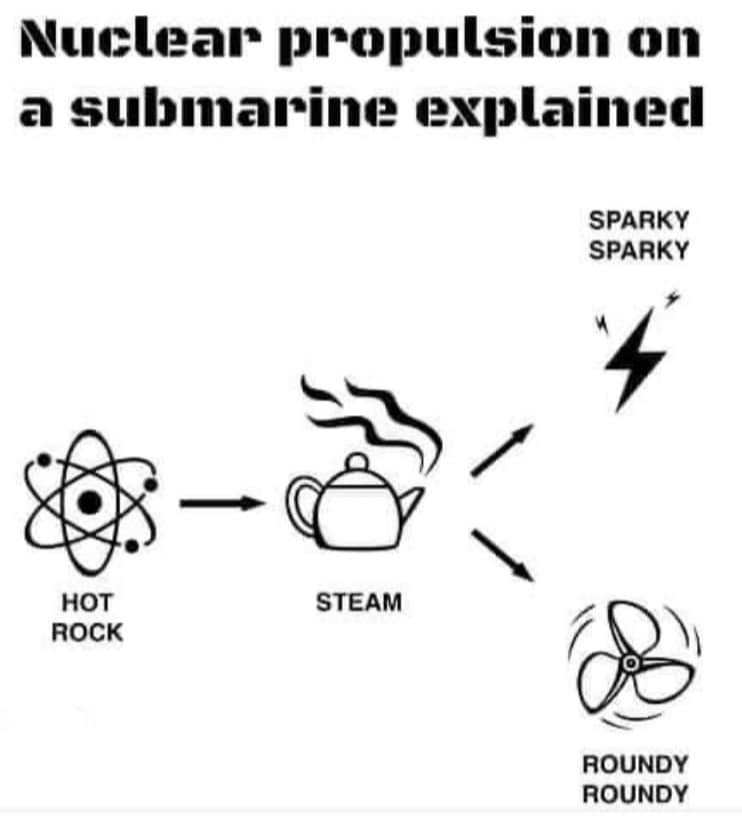
The next 6 months is nuclear power school. Here you will learn how the hot rock makes the propeller spin and electricity magically appear. You have to memorize all of it. It was all essay questions. You could explain it perfectly, but miss one key word or tricky phrase and drop the question. At the end of it your brain is mush and all you remember is:
The next phase is called Prototype. No idea why, because the submarines you were working on were probably older than your parents. I was assigned to the MTS-626. It was commissioned in 1964, when my mother was 3. Here, you practiced actually operating a nuclear reactor. You started it up, shut it down, tripped it, pretended to break it. Over and over again, until you could do it by yourself without your babysitter yelling at you too much. At the end of this 6 month block, you were a qualified nuclear operator, kind of.
If you survived this crucible, you got to go to the fleet. There, you got to learn how an actual modern nuclear plant worked. You were given 18 months to fully qualify all watchstations for your assigned rating. At this point you’ve been in the Navy for about 4 years. Assuming you don’t reenlist (for the love of God, don’t), the next 2 years are pretty easy. Easy as in you’re not being treated like shit because you’re not qualified, but you’re never home and don’t get to sleep for more than 4 hours at a time.
You’re now a Veteran. You survived the Navy and get to relish in all the holidays, because they’re really all about the Troops. You’re 24 years old and want nothing more than to never read another reactor plant manual again. Then you start looking for a job. All entry level positions want 10 years experience and a masters degree, and they pay minimum wage. Or, you can admit defeat and apply to be an operator at a nuclear power plant. Sure, you’ll never see the sun again, but they’ll pay you twice what you made in the Navy. Bonus points, your crippling insomnia is a strength on rotating shift work.
That’s how I ended up where I am at. I have held 3 different jobs in civilian nuclear power. I was an instructor for about 5 years. I got my SRO certification, which says I know just as much as an actual Senior Reactor Operator. Really, you know just enough to talk competently about how to run the place, but it takes years to really figure it all out.
We moved to AZ, where I was an equipment operator for a few years. This is the entry level operator job. You work out in the really hot steam plant. Money’s good, $60/hr or so once you are fully qualified, but did I mention it’s a steam plant? Steam is really hot, and it was in Arizona which is also really hot. It’s 140F in the turbine building. You step outside into the blissful 120F desert to cool off. It’s really great.
After a few years of pretending we had acclimated to the heat, we moved back to MN, where I went back to training for 5 more years. I decided to get my license. The class to do that takes 2 years. Seeing as I had taught people how to do it for almost ten years, I tried my best not to get caught sleeping. I passed the NRC exam and was an SRO on shift for 2 years. Now we are in MD and I am teaching again.
There are a few other options. We have technicians of all kinds. Electricians to work on motors and circuit breakers. Instrument technicians to work on, well, instruments. Mechanics and riggers and machinists. Chemists and radiation protection specialists. A lot of them have Navy backgrounds too. But many don’t.
Another, newer option, is a Power Plant Technology Associate’s Degree. A lot of nuclear plants have worked with local community colleges to develop these programs. They meet the minimum requirements to get you in the door. You don’t even have to live under water for any length of time. Not sure how that counts, but we hire quite a few of these kids now.
Despite the tone of some of the above, I love what I did in the Navy and love what I do now. I make a ridiculous amount of money for someone without a degree. Or someone with a degree for that matter. The average intelligence of the people you work with in nuclear is so far beyond the normal world that even the stupid people are really smart. I’ve worked outside nuclear and it’s hard to fathom just how smart the nukes are in comparison to normal people. Shift work can suck, but there are a lot of opportunities to get into a day job once you have a little experience.
If you have questions, please ask in the comments. I will probably do another post describing the different operator jobs more, what the requirements are to do them, and how the training programs work. And what the pay is like. Turns out most of use work because they pay us.
Also, don’t let the college dropout demographics worry you. The people I work with are smart and are dedicated to one thing. We will operate the plant safely. We live nearby. Our families and friends live nearby. We aren’t idiots or mad scientists. We respect the power we control. So, despite our apparent inability to attend classes regularly when we were teenagers, we’re really good at what we do.
 Sleepy Neutron's Nuclear Knowledge
Leave a comment