Nuclear power plants are required to comply with the conditions of their NRC-issued license at all times. A large part of this is contained in what are called technical specifications, also known as Tech Specs. The link to all currently approved Tech Specs is below.
https://www.nrc.gov/reactors/operating/licensing/techspecs/current-approved-sts.html
Tech specs provide a box that you have to stay within in order to run a reactor. This box consists of various operating rules, such as not allowing power to rise above 100% or temperature to rise above the design limit, as well as equipment requirements. These rules vary depending on the exact condition, or mode, of the reactor.
There are a lot of rules. The Tech Specs (Volume 1) is 542 pages. Volume 2 is the basis document, which explains what all of Volume 1 really means. It’s 1030 pages. As a licensed operator, you have to know this well and refer to it any time a question comes up.
Modes are defined in tech specs. Mode 1 is where plants spend most of their time. The reactor is critical, power is usually at 100% and we making electricity. Mode 2 is Startup, but we are not putting power out on the grid yet. Mode 3 is Hot Standby, where the reactor isn’t critical, but the plant is close to normal operating temperature. We don’t spend a lot of time here, it’s mainly a waiting place to either go up to Mode 2 or cool down to Modes 4 & 5. Mode 4 is Hot Shutdown. Mode 5 is Cold Shutdown, where we go to do maintenance (<200F, so no steam). Mode 6 is refueling, which means you’ve taken the top off the reactor to access the fuel.
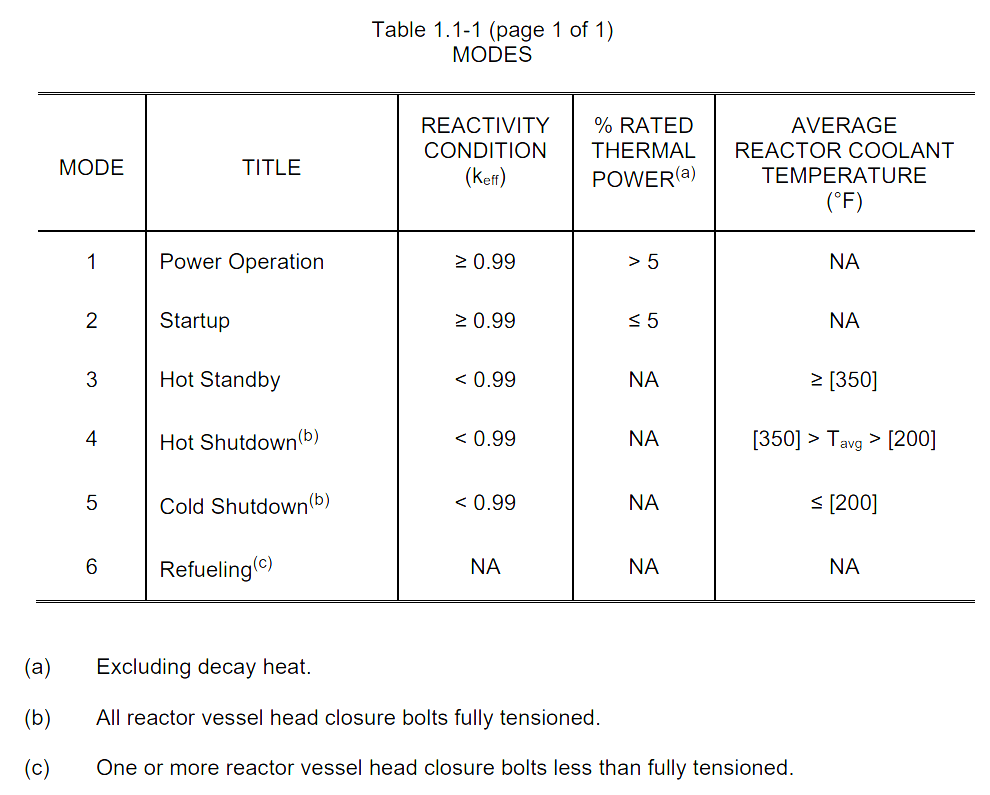
Tech Specs are most limiting in Mode 1, and to a lesser extent, Modes 2 and 3. The reason is the reactor is hot and contains the most energy in these modes. As you cool the reactor down to M4 or M5, there is less energy, so you need less equipment to handle any possible events.
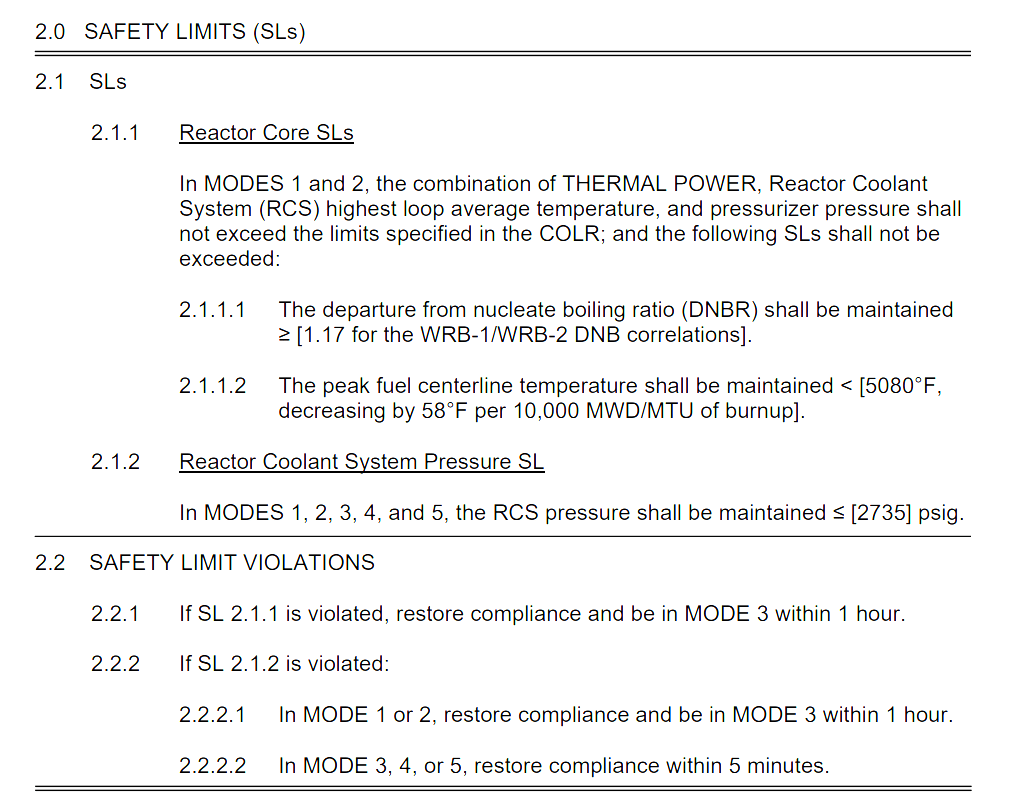
Tech Specs has a section for safety limits, Section 2. It’s pretty short & to the point. You cannot exceed SLs. DNBR is a measure of how close to damaging localized boiling the core is – you have to keep it above 1.17, so 17% margin from boiling. You can’t let the fuel get too hot, for obvious reasons. You also cannot overpressurize the Reactor Coolant System, otherwise it might break. If you violate safety limits, you do NOT get to keep operating, and the NRC will probably take away to keys for a while.
Sections 3.1 and 3.2 lay out the rules for controlling power in the reactor and monitoring control rod positions. If you misalign control rods you can force power to move from one side of the core to the other. This peak can cause you to violate your SLs in a small section of the core, possibly damaging fuel.
The equipment-related section is easiest to explain, and it begins in Section 3.3, which concerns instrumentation and runs through 3.9. 3.3 lays out all the instruments you are required to have operable. Operable means capable of performing its required function, and is something we test frequently. If you look at the snip below, you can see one of the 3.3 sections. This is for instruments that feed automatic or manual reactor trips.

This TS says that you have to have certain instruments operable. These are listed in a table. If they are all operable, great, you can keep on operating. Condition B, for manual reactor trips, is easiest to understand. We have 2 trains of manual trips (literally 2 buttons that go to 2 sets of circuit breakers). You push the buttons and control rods fall into the core, shutting the unit down. Either train by itself will cause a trip, but we have 2 just in case when I go to push the buttons, one doesn’t work. If 1 of these 2 manual trips doesn’t work, you have to take the required action. In this case, it basically says fix it (that’s what restore to operable status means). And it gives you a completion time of 48 hours (the stuff under the OR, called RICT, gets really complicated and we can’t always use it, but it can give us a little more time.)
So, what if you can’t fix it in 48 hours? There is another condition for that, in this case, Condition Z. It says that you didn’t meet the required action within the required time and gives you new actions. If this happened in the plant, you would have to go to Mode 3 (make the reactor not critical anymore) within 6 hours.

This is what Tech Specs does. If you don’t have the required equipment to be in a certain mode, it drives you to lower modes. This puts the plant in a safer condition, with less energy to control. I’ll do one more example, this time for a pump.
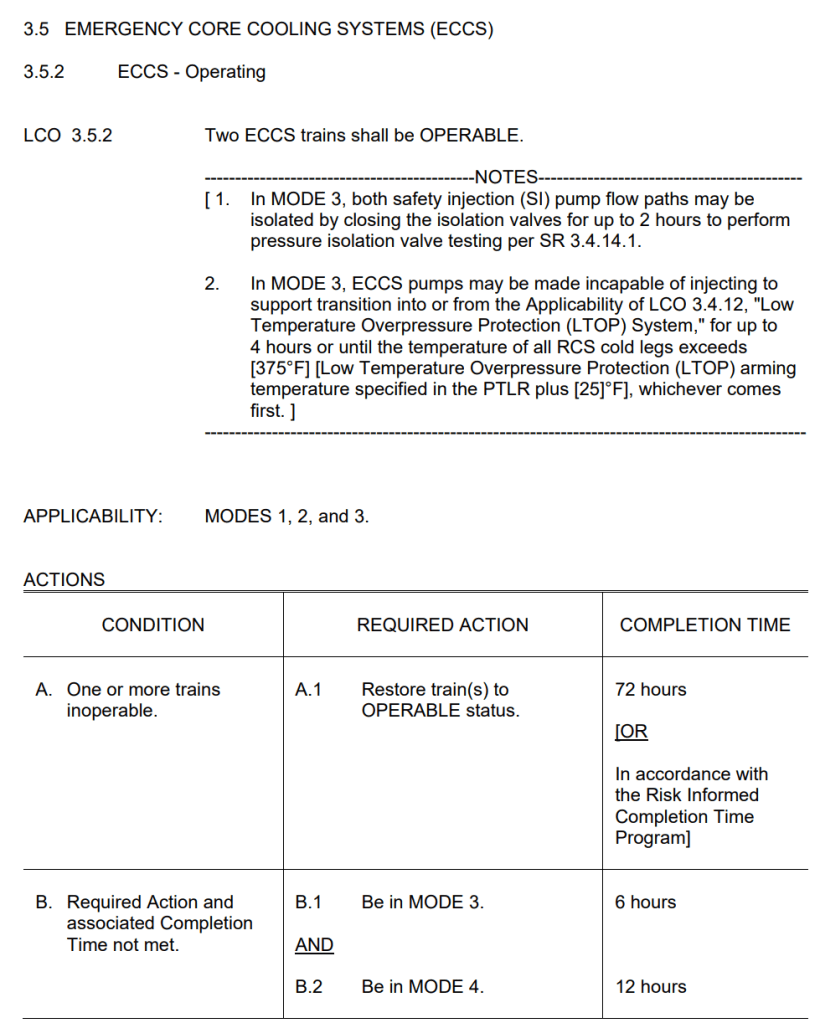
This is the TS for the Emergency Core Cooling System. This system automatically starts pumps that refill the reactor core if a large leak occurs. It is required in Modes 1, 2, and 3. It says that 2 trains (again, identical redundant equipment, just in case 1 breaks when an accident happens) are required. A train usually consists of 2 pumps, one high-pressure pump, and one low-pressure pump. Let’s say that 1 of my high-pressure safety injection pumps is broken.
This would require me to look at Condition A, which gives me 72 hours to fix it. If I can’t, I go to Condition B, which says to shutdown to M3 within 6 hours and M4 in another 12 hours (18 hours total). So, if 1 required pump breaks, I get a chance to fix it. If I can’t, I shutdown and cool down the reactor to put it in the safest possible condition.
This is an important concept. Nuclear plants in the US cannot just ignore equipment issues if the equipment in question is at all required to keep the core safe. We get a chance to fix it because the risk of an accident is very low and the requirements to call something operable are very high. If we can’t, we don’t get to make power (or money) until we do.
As a licensed SRO, if I accidentally violate these Tech Specs, I could get in a ton of trouble. If the NRC thought I did it willfully, I could end up in jail. SROs don’t mess around with tech specs. We don’t care if the VP is pissed that the company will lose money. If the Tech Specs say shut it down, we do it. The VP can fire me. The NRC can put me in prison. They win.
 Sleepy Neutron's Nuclear Knowledge
Leave a comment